
Reviews / 2012-03-06
Ducati Monster 696+
This article was originally written in Turkish and translated with the help of artificial intelligence.
A thousand kilometres have passed with the new toy. Most were spent on roads around Bursa, where my impressions formed, wrestled with my prejudices and finally developed. In addition to standard equipment, it has Termignoni carbon exhausts, an air filter and a chip with the matching software, plus what I consider a poor choice of tyres. It has a few cosmetic additions too, which I will mention in due course. I bring these up now because they directly affect the ride and comfort.
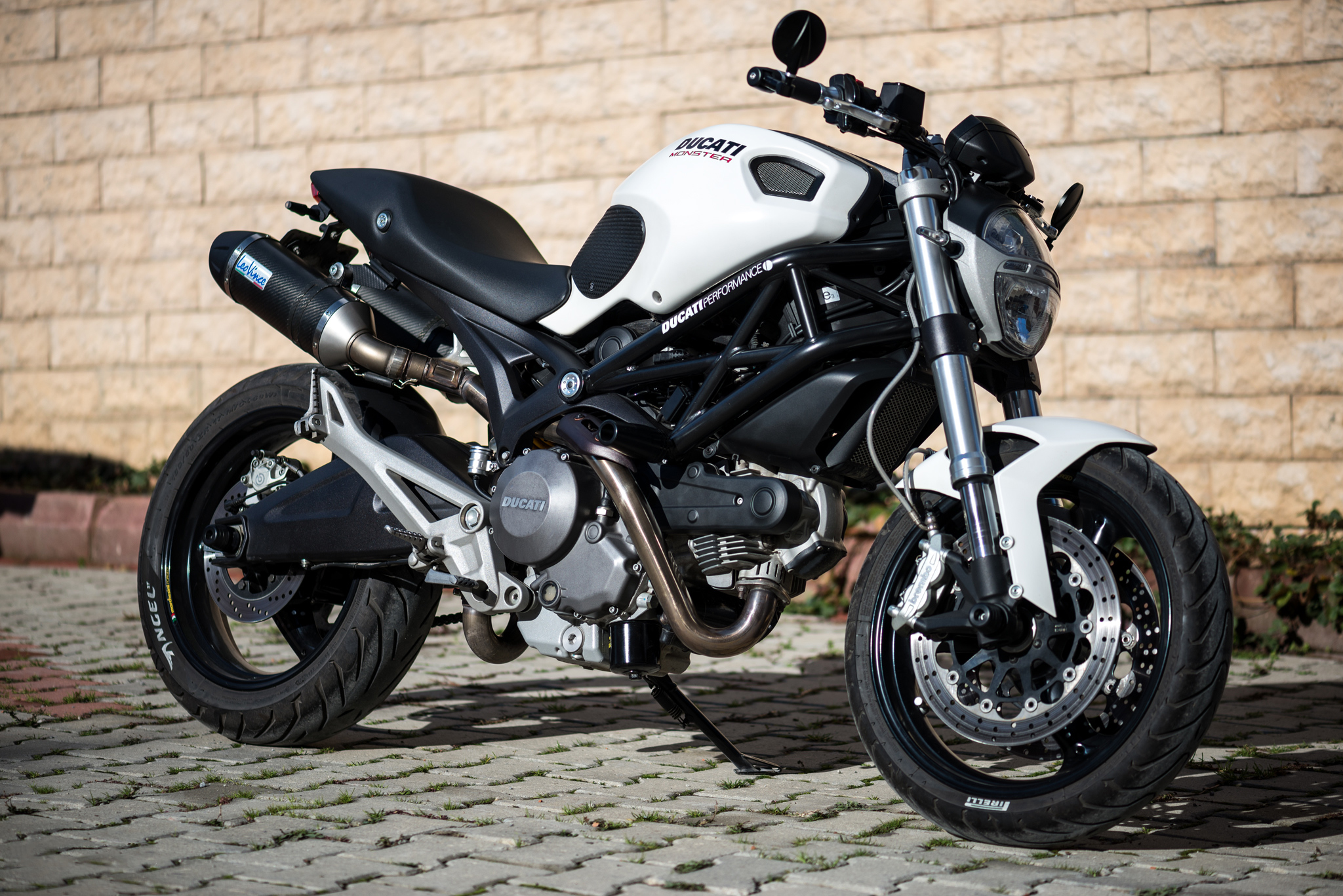

The Monster is classic Italian design, naked and attractive. It is quite small and genuinely light at 161 kg. With its exhausts it has a rumbling, popping yet wonderful sound, though on paper its engine is relatively weak beside its rivals, at around 80 HP. On my first ride I loved the sound, but found its performance below 4,000 rpm inadequate and even uncomfortable. It is awkward at low speeds, but Ducati has finally discovered the multi-plate wet clutch. Using the clutch as part of your riding makes it possible to ride smoothly in town. Bring the engine near its proper rev range, and the sound, like a symphony to my ears, and its sweet drive really entertained me. I cannot be modest here: engine and exhaust are a magnificent pairing, an example for all the other brands. Wonderful!
At 6,000 rpm the engine is lively and eager, but the happiness is short-lived: a red light starts glowing at 9,000 to tell you to change gear. Ignore it and the limiter cuts in at 9,500. Frankly, this annoyed me a little. For a wrist used to the broad rev range of 600 cc four-cylinder machines, it was a troublesome adjustment. I hit the limiter repeatedly and lost progress in long bends. I think it took around 500 km to get used to it. I should mention that my route had lots of bends and few straights; elsewhere it might have taken longer.
Once I had adjusted to the narrow rev range, I can say it was one of my most enjoyable rides to date. The Monster is a true naked bike. It is easy to steer, holds its line consistently and feels grippy and composed despite the strange tyre choice. I have mentioned those tyres twice, so let me explain. The front is a Michelin Pilot Power 2CT and the rear a Michelin Pilot Road 2CT, with an oversized 170-section rear chosen instead of a 160. You have probably heard the advice: do not deviate from the original size, it makes steering harder and spoils the handling. This bike is an excellent example. Looking at the tyre wear marks in the photo above, you can easily see it too. When the front tyre reaches its limit, the rear still has about 2 cm to spare. When a rider in control of the bike starts leaning it, the front will lose grip first, precisely the opposite of what any sensible motorcyclist wants. Of course, it should not slide; indeed, we should not lean it to its limits, but keep that margin in reserve for safety. Yet what happens when you need to use that margin? In the end, I ought at least to go and get a 160-section rear tyre.
170ta.jpg
During this initial adjustment phase, my wrist was more active than usual just to hear the engine, yet I liked the fuel consumption. I think it will fall a little from now on and reach 5–5.5 L/100 km.
122784.png
Even if it does not drop further, it is the most economical 600-class bike I have ridden enough to assess consumption.
Let's continue. The riding position is initially intimidating. It looks tiring, especially since I am a little large for this bike, but by the end of the day I am not tired and have no aches or pains anywhere. Vibration is greater than on a four-cylinder, but I have not found it bothersome. Perhaps you might dislike the shuddering if you trust the torque and open the throttle in a high gear at low revs, but why would you, when you can use the correct gear and revs?
The brakes are good and the suspension is good. I was a little concerned when I could not find the adjustments I wanted. Showa has done its job properly again; there is no need to touch it. Brembo's brakes are as successful as the Showas. If you are interested in this bike, I do not think you need chase the optional ABS at all. With its frame and suspension, the Monster really is a good motorcycle. Have no worries on those fronts.
Now for a real problem. You may know that, on Italian motorcycles generally, mirrors seem almost optional: an accessory, a cosmetic touch. This bike also has Rizoma Tomok mirrors. Most of each mirror shows me, with the rear visible in only one or at most two centimetres at the tip. The original mirrors looked more sensible to me. I hope they are still around so I can fit them; these mirrors are troublesome.
There is another problem. At the back, a smaller item has replaced the original number-plate holder. You may have noticed that the rear tyre extends well beyond the tail. Never mind rain: even a small puddle sends water right up to the top of your helmet. The photo below shows the result after merely crossing a puddle at 10 km/h.
img1080xl.jpg
I hope the original tail is still around too.
To sum it up, this is a motorcycle that looks good, handles well, uses little fuel and makes wonderful noises. It is very enjoyable and easy to ride. The brakes inspire confidence. I do not know its top speed, but imagine something around 210–220 km/h. It is a very light motorcycle with smile-inducing acceleration. Low and short, small but wild enough. Did I mention that it sounds wonderful? This is not a model for fitting top boxes and panniers; perhaps two soft side bags, and I think there is a bag solution inside the handlebar area. The tank is plastic, so magnetic tank bags cannot be used either. In other words, it is not a very practical motorcycle. Did I mention how much fun it is?
Service intervals are 12,000 km. I do not think servicing and running it are expensive. I will share my experience of those matters when I have some.
As you know, my Monster adventure is over for now. After the kilometres that have passed, I wanted to remember the old flame. icon_smile.gif
img1222iq.jpg
In this shot it poses without the single-seat cover, as if reminding us it is actually a two-person motorcycle. Perhaps because she liked it so much, Esra complained only about the lack of grab handles, and otherwise said she was comfortable. Optional passenger grab handles do exist, by the way; like most, mine had not been fitted with them.
As you may remember, my Desmo differed a little from standard. I welcomed most of those changes, but one really challenged me: the mirrors. They were very stylish, and I could not bring myself to remove them, but seeing behind me took far too much effort. The colour of the mirror glass is interesting; I do not remember ever being bothered by reflections. Of course, that might also be down to their size. Speaking of size, one benefit of the small mirrors was that my shoulder checks improved and became a natural part of my riding. icon_smile.gif
img1083m.jpg
While I am at it, let me continue with the negatives. Mine also had a “short tail”, with a smaller number plate and indicators fitted as a result. It became a bike that sprayed mud as far as my helmet in the rain and whose indicators were hard to notice in daylight. Likewise, the incorrect tyre choice brought fear and me rather close together. :P Finally, when it goes in for service, make sure the studs and nuts are checked. Remember it is Italian.
img1349kh.jpg
Looking at the picture above, I suppose I must also admit it was a little “small” for me.
Overall, it was a motorcycle that broke down most of my prejudices. Combine desmodromic valves with a V-twin engine and Termignoni carbon exhausts on the outlet, and you have a wonderful combination. Subjectively, this Monster was the two-wheeler whose sound I enjoyed most. The front screen achieves more than its appearance suggests, but the Monster is a naked bike. You befriend the wind and travel with it. Far from the frightening experience you might imagine, it is a freedom that lets you become part of your surroundings. I would say: do not end your motorcycling life without enjoying it.
img1072cj.jpg
During our time together it developed no mechanical problem. I did not even change the oil. Although a 2009 model, it never once failed to start. My only problem was the O-ring chain, chosen for its looks because it was red. I had to keep adjusting it from the day I bought the bike to the day I sold it, and never had much confidence in it. Although it looks handsome in the photo below, steer clear of this chain, which in my opinion is rubbish. DiD VX is good; it is a friend for life.
img1416yw.jpg
The headlights do a very good job for a naked bike. In classic Ducati fashion, there are no hazard warning lights. But it is clever: if you leave the headlights on with the engine stopped, it turns them off itself. The first time, I was sure a fuse had blown; it never occurred to me that it might have such technology. I generally do not much like digital instruments, and the Monster is entirely digital. Although I grumbled a lot at first, I got used to it. The red LEDs that remind me I am approaching the end of the rev range and then flash insistently in my eyes proved very useful. With toys such as a lap timer and dynamic data logger too, you could even say I grew to like it.
When it came to riding, my Desmo surprised me again. I had been put off by the front suspension's lack of full adjustment. Riding it, I realised there was no need to fiddle anyway. I only increased the rear Sachs preload a little, then let the fun begin. Its sound and low-down torque sometimes tempted me into mischief. I think it is a very good package. The new APTC clutch suits it extremely well; with a proper tyre, you have to commit a deliberate foul to unsettle the rear. icon_twisted.gif.bak Although the lever controlling the front Brembos needs quite a squeeze, its stopping ability surprises the rider. Then again, perhaps it should not, remembering that the standard bike weighs 161 kg and mine 157 kg. Why the difference? Carbon parts and the exhaust system. icon_twisted.gif.bak
img1549uh.jpg
The Ducati Monster 696+ is ultimately a sporty naked motorcycle built around a view I deeply believe in: “less is more”. It does everything it says it will, and does it well. It is quite robust and reliable. Service intervals are every twelve thousand kilometres, and it uses little fuel too. On my rides it ranged between 5 and 7 L/100 km; remember my bad chain and my weight. With its upside-down light-alloy front forks, light but rigid structure, light twin-sided swingarm and Brembo twin-piston calipers with 320 mm discs, it is a very competitive product. It is light, low and easy enough to almost be a beginner's motorcycle, yet capable and mischievous enough to entertain advanced riders. A little short on power; confident wrists can take a look at the 1100 Evo. Its interchangeable body panels, something we are not used to, leave it wide open to personalisation. Though the Ducati badge makes such cosmetic parts expensive, at the current promotional price of 20,000 TL I think it is very attractive. The promotion has ended; 2014 prices start at €10,900. :(
img1437o.jpg
Speaking of attractive: it truly is an attractive motorcycle. A design that draws everyone's interest, whether they know about bikes or not, and makes them smile. It is very nimble in town, as though it could do anything a scooter does. On hot summer days the air-cooled engine reminds you it is there, as if it were possible to forget the monster making that noise!
I have just realised I miss it. icon_heartbeat.gif